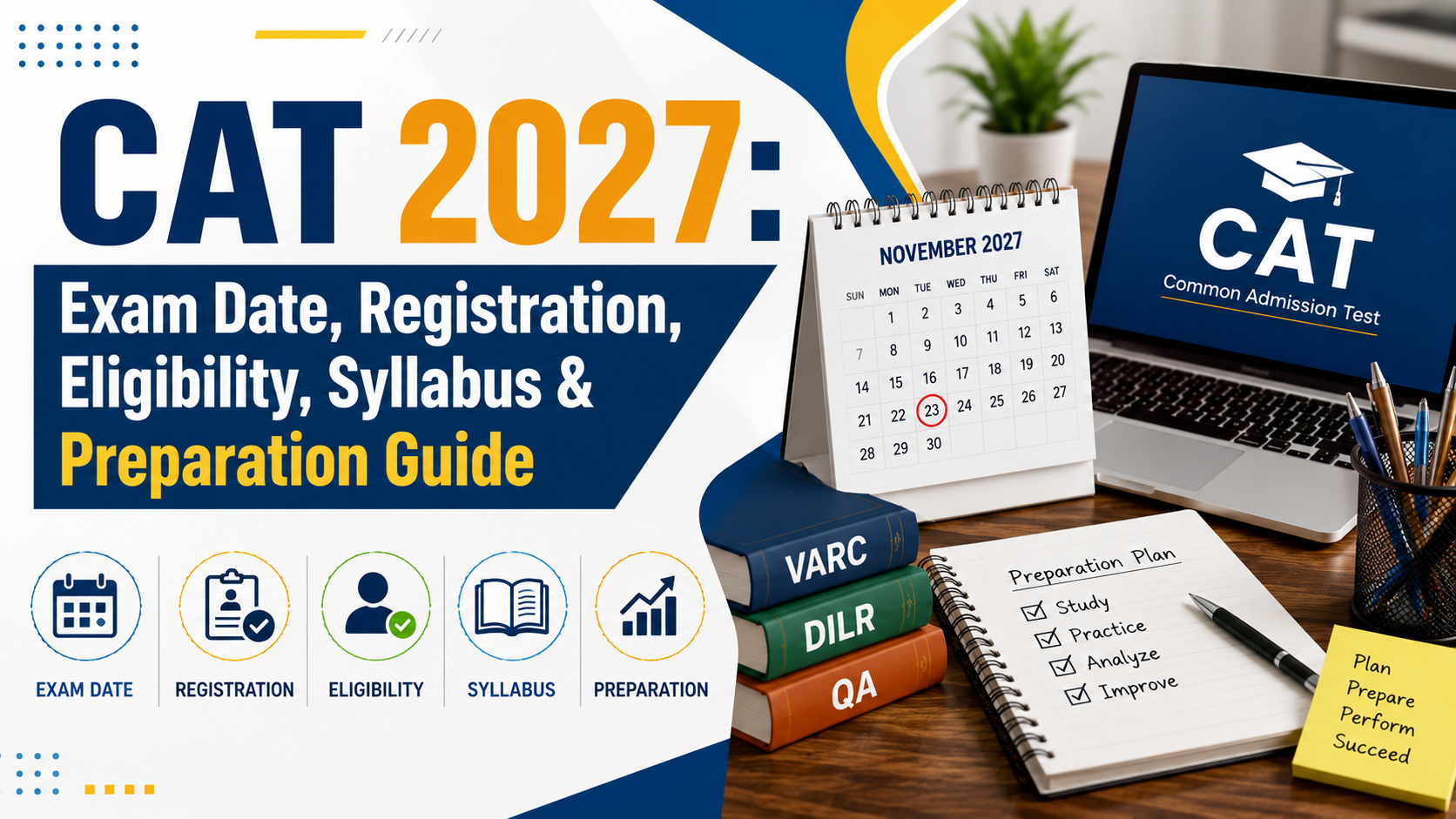
Note: The official CAT 2027 notice will come out around July 2027. All the dates and details listed below are based on past exam trends and expected schedules.
Preparing for CAT demands good planning, time and focus. If you are planning to take the CAT 2027 exam, starting your preparation early gives you a massive advantage over other students competing for the same college seats.
In this guide, we break down expected exam dates, basic eligibility rules, section-wise syllabus topics and simple study plans that you can actually follow without feeling overwhelmed. Let’s make your preparation easy and stress-free.
When Will CAT Exam 2027 Be Conducted?
The CAT 2027 exam will most likely happen on the last Sunday of November 2027. You can expect the official exam notice to come out in July 2027. And the online application portal will open soon after that.
|
CAT 2027 Event |
Expected Timeline |
|
Official Notification |
Last week of July 2027 |
|
Registration Window |
August to September 2027 |
|
Application Correction Window |
Late September 2027 |
|
Admit Card Release |
Late October /Early November 2027 |
|
CAT 2027 Exam Date |
Late Novermber 2027 |
|
Answer Key & Response |
First Week of December 2027 |
|
CAT Result Declaration |
Late December 2027/ Early January 2028 |
Who Can Apply for CAT 2027?
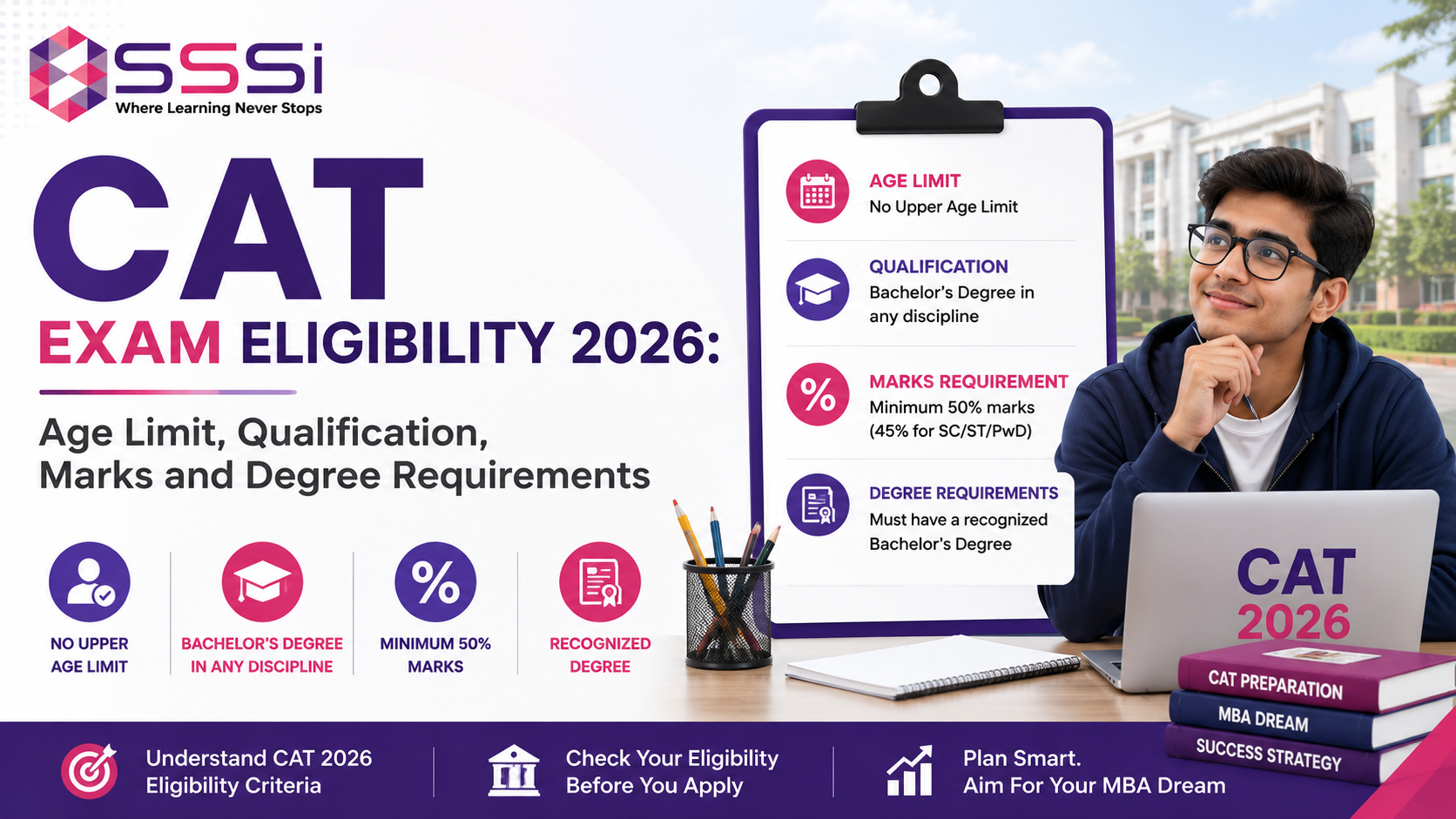
To fill out the application for CAT 2027, you just need to clear a few basic rules set by the Indian Institutes of Management (IIMs).
You need a Bachelor's degree from a recognized college. Most students need at least 50% overall marks or the same level in CGPA. But if you fall under the SC, ST, or PwD categories, your target score drops to 45%.
Students in their final year of college are fully eligible to sit for the exam. You can also apply if you have a professional degree like CA, CS, or CMA. Best of all, anyone of any age can register for CAT.
One Important Detail: Passing this eligibility check lets you sit for the exam. But when it comes to interview calls, each IIM checks extra factors like past school grades, work experience and your background.
How Does CAT 2027 Registration Work?
Signing up for the CAT 2027 exam is 100% online. You complete the full application through the official CAT website.
Here is how to complete your form in 6 easy steps:
- Create Account
Visit the official CAT portal and register with your name, birth date, email and phone number to get your login ID.
- Fill Details
Log in to enter your personal information, school marks, college scores and category details.
- Add Job Experience
Enter any full-time work completed after graduation. Freshers can skip this step.
- Choose Programs & Cities
Select your preferred IIM courses, interview locations and pick six test cities near you.
- Upload Documents
Upload scanned copies of your photo, signature and category certificates.
- Pay & Submit
Pay the fee online using a card or net banking, then download your final confirmation page.
What Is the CAT 2027 Exam Pattern?
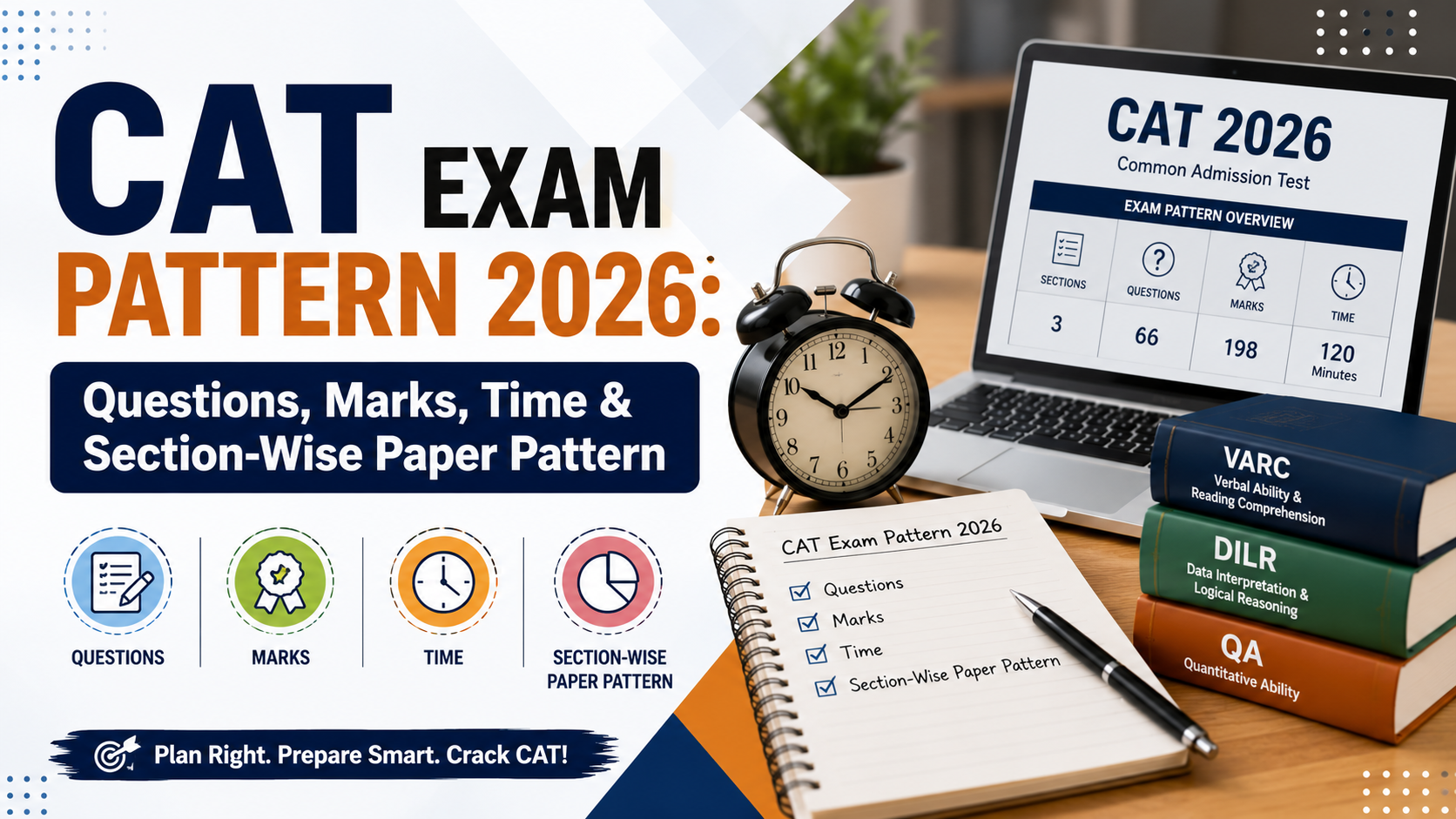
CAT is a computer-based exam with three fixed, timed sections. You finish the whole paper in one sitting.
|
Parameter |
Details |
|
Total Duration |
120 minutes (40 minutes for each section) |
|
Total Questions |
Expected 66 questions |
|
Question Types |
Multiple Choice (MCQs) and Type-In-The-Answer (TITA) |
|
Marking Scheme |
+3 marks for every right answer |
|
Negative Marking |
-1 mark for wrong MCQs; No negative marks for TITA |
|
Sectional Timing |
Strict 40 minutes per section; you cannot switch early |
Section-Wise Breakdown
- Verbal Ability & Reading Comprehension (VARC): 24 Questions | 40 Minutes
- Data Interpretation & Logical Reasoning (DILR): 20 Questions | 40 Minutes
- Quantitative Aptitude (QA): 22 Questions | 40 Minutes
What Is Covered in the CAT 2027 Syllabus?
The IIMs never publish a fixed chapter checklist. But when you look at past papers, the core topics stay fairly consistent across all three parts of the test.
|
Section |
Main Topic Focus |
|
VARC |
Reading passages, sentence order, paragraph summaries, odd sentence out |
|
DILR |
Data tables, charts, seating puzzles, Venn diagrams, caselets, game rules |
|
QA |
Arithmetic, algebra, geometry, number systems, modern math |
Verbal Ability & Reading Comprehension (VARC)
- Reading Comprehension
Short and long passages about business, philosophy, science, and history.
- Para Jumbles
Sorting mixed-up sentences back into the right order.
- Para Summary
Picking the single sentence that best sums up a short paragraph.
- Odd Sentence Out
Spotting the line that does not belong in a paragraph.
Data Interpretation & Logical Reasoning (DILR)
- Data Sets
Reading tables, bar graphs, pie charts and combined charts.
- Logic Puzzles
Solving linear and circular seating arrangement clues.
- Team Selection
Grouping people together based on strict conditions.
- Routes & Networks
Working out paths, tournament scores and game match-ups.
Quantitative Aptitude (QA)
- Arithmetic
Percentages, profit and loss, ratios, averages, time and work, speed-distance-time.
- Algebra
Simple equations, quadratic formulas, functions, inequalities, logarithms.
- Geometry
Triangles, circles, coordinate geometry, 3D shapes.
- Number Systems & Modern Math
Divisibility rules, prime numbers, probability, set theory.
How Should You Prepare for CAT 2027?
To clear CAT, you need a plan that builds your basics first, speeds up your problem-solving next and teaches you which questions to pick on test day.
Here is a simple 4 step plan you can follow:
- Months 1 to 4 (Learn the Basics)
Focus on core math formulas, basic algebra and daily reading. Don't worry about speed yet. Just work on getting your answers right.
- Months 5 to 7 (Practice Sections)
Solve short topic quizzes and tackle at least one DILR puzzle every day. Start using a timer so you get comfortable with the clock.
- Months 8 to 9 (Solve Past Papers)
Practice real CAT papers from the last 7 to 8 years. This shows you how hard the actual test gets and what questions repeat.
- Months 10 to 12 (Take Mock Tests)
Write 20 to 30 full-length practice tests. Always check your wrong answers afterward to fix small math slips.
If hard math chapters or complex logic sets slow you down, getting a bit of extra help can save you weeks of confusion. Live, 1-on-1 tutoring at SSSi lets you work through weak topics at your own pace with a dedicated mentor.
What Should Be Your CAT 2027 Study Schedule?
Pick a timeline that matches when you start your preparation:
- 12+ Months Plan (Early Start)
Spend your first 6 months clearing basic Quant concepts and reading every day. Use your remaining months for logic puzzles, past papers and full-length mock tests.
- 6 to 9 Months Plan (Standard Track)
Finish core topics during your first 3 months. Move straight into daily sectional practice tests and keep the final 3 months for full mocks and error checks.
- 3 to 4 Months Plan (Crash Track)
Focus mostly on high-scoring topics like Arithmetic, Algebra and Reading passages. Solve previous 5-year papers and take 2 mock tests each week.
Master the CAT 2027 Syllabus with SSSi
Studying for CAT by yourself can get overwhelming, especially when you run into tough math problems or long DILR sets. Working with an expert guide helps you understand topics much faster without the stress.
At SSSi, we provide a live online tuition class setup tailored to your exact prep level.
Our tutoring helps you master the syllabus in three simple ways:
- Targeted Learning
Focus deeply on high-yield areas like Arithmetic, Algebra and RC passages.
- Instant Doubt Clearance
Ask questions directly during live sessions so you never stay stuck on a concept.
- Custom Pace & Strategy
Learn how to manage your time, pick the right questions and use shortcuts that boost your score
Reach out to our team at SSSi today to book a trial class and build a study plan that fits your goals.
What Happens After the CAT 2027 Exam?
Taking the written exam is just the first step toward getting into an IIM. Once the test is over, here is how the admission process works step by step:
- Results Out (Late Dec / Early Jan)
The official scorecard comes out, showing your section scores and overall percentile.
- IIM Shortlisting
Each IIM posts its own shortlist based on your CAT score, past school marks, work experience and degree background.
- Interview Rounds (WAT & PI)
If shortlisted, you attend a Written Ability Test (WAT) and a Personal Interview (PI). Some colleges also hold Group Discussions (GD).
- Final Admission Offer
Institutes calculate a final composite score using your CAT performance, interview performance and profile points to send out admission offers.
Frequently Asked Questions
-
Is CAT 2027 registration open?
No. Registration for CAT 2027 officially opens in August 2027, right after the official notification comes out in July 2027.
-
Can final-year college students apply for CAT 2027?
Yes. If you are in your final year of college, you can apply without any issue. You just need to finish your exams and show proof that you passed by the date set by the colleges.
-
Is there negative marking in CAT 2027?
Yes. You lose 1 mark for every wrong answer on Multiple Choice Questions (MCQs). Non-MCQ or type-in questions (TITA) carry no negative marks at all.
-
Does a 99+ percentile guarantee admission to an IIM?
No. Scoring a high percentile gets you selected for the interview round. Final admission offers also depend on your past school grades, work experience, category status and interview score.
-
How is work experience counted for CAT 2027?
Only paid, full-time jobs done after finishing your degree count. Internships, part-time work, CA articleships and college projects do not count as work experience.
-
Do non-engineers get extra marks in CAT shortlisting?
Yes. Everyone answers the exact same CAT paper, but individual IIMs give extra diversity points (usually 2% to 5% of the total shortlisting score) to non-engineering graduates when calling students for interviews.