Planning for the Common Admission Test (CAT) gets confusing if you do not have a clear plan. The official IIM notification gives you the test dates and pattern. But it never gives you a neat, chapter by chapter list of topics.
So, what should you actually study? Which topics carry the most marks?
We looked at years of real CAT question papers to build this simple guide. Here is the full CAT syllabus for Verbal Ability and Reading Comprehension (VARC), Data Interpretation and Logical Reasoning (DILR) and Quantitative Aptitude (QA). Let’s prepare for CAT with the right strategy and get admission to a top institution.
What Is the CAT Syllabus 2026- 2027?
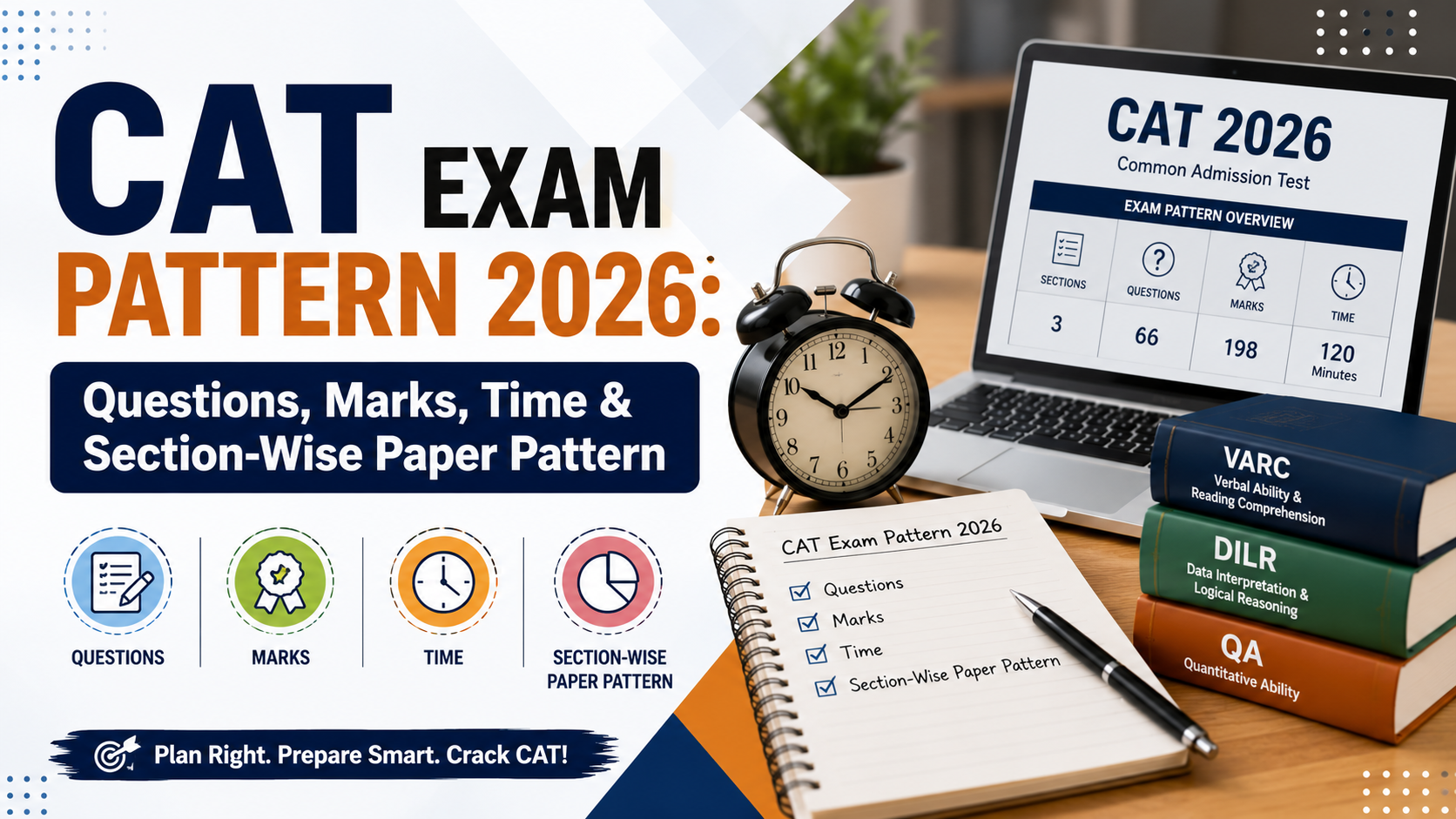
The CAT syllabus covers three test sections: VARC, DILR and QA. You have to answer 68 questions in 120 minutes. You get exactly 40 minutes for each section. And you cannot jump between sections.
|
CAT Section |
Questions |
Time Limit |
Main Topic Focus |
|
VARC |
24 |
40 mins |
Reading passages, paragraph summaries, jumbled sentences |
|
DILR |
22 |
40 mins |
Data tables, graphs, logic puzzles, seating arrangements |
|
QA |
22 |
40 mins |
Basic math, algebra, geometry, number systems |
|
Total |
68 |
120 mins |
3 Sections |
The test checks your logic, reading speed and problem-solving skills. This means you do not need to memorise huge textbook definitions, as here your critical thinking ability works the most.
How Is the CAT Syllabus Structured Across Sections?
The test uses two types of questions:
- Multiple Choice Questions (MCQs)
You pick one answer out of four options. Wrong answers lose you 1 mark.
- Type-In-The-Answer (TITA)
You type your answer using a screen keypad. There is no negative marking for wrong answers.
|
Section |
Core Syllabus Areas |
Question Types |
|
VARC |
Reading comprehension, sentence order, odd sentence out |
16 RC questions, 8 Verbal Ability questions |
|
DILR |
Tables, arrangements, charts, team selection rules |
4 to 5 data sets with 4 to 5 questions each |
|
QA |
Ratios, equations, shapes, number properties |
Standalone math problems |
The core CAT exam syllabus stays mostly the same every year, but if you see that some exams are shifted, then that could mean this exam can bit harder than others.
What Topics Are Covered in the CAT VARC Syllabus?
The CAT VARC syllabus tests how fast you read and how well you understand written English. Reading Comprehension makes up two-thirds of this section. Verbal Ability makes up the rest.
Reading Comprehension (RC)
- Main Idea
Finding the central point of the passage.
- Inference
Understanding points that the author suggests without saying directly.
- Author Tone
Spotting if the writer feels positive, negative or neutral.
- Passage Arguments
Finding strong evidence or weak points in the text.
Verbal Ability (VA)
- Para Jumbles
Putting mixed-up sentences back into the right order.
- Para Summary
Picking the single sentence that sums up a short paragraph.
- Odd One Out
Spotting the single sentence that does not fit with the rest.
- Sentence Placement
Placing a new sentence into the right spot in a paragraph.
Read news articles and books every day to build reading stamina. If you need help with reading speed or grammar rules, getting personal guidance through SSSi can help you fix weak spots fast.
What Topics Are Included in the CAT DILR Syllabus?
The CAT DILR syllabus does not use long formulas. Instead, it tests how quickly you can understand raw numbers, tables and logic puzzles.
Data Interpretation (DI)
- Tables
Reading numbers directly from clean data charts.
- Bar Graphs and Line Charts
Tracking changes, growth rates and drops over time.
- Pie Charts
Calculating percentages, parts and total values.
- Caselets
Turning long word stories into structured math tables.
Logical Reasoning (LR)
- Seating Arrangements
Placing people in lines, circles or grid rows based on clues.
- Games and Tournaments
Working out match scores and knockout points.
- Routes and Networks
Finding the shortest path or traffic movement across map points.
- Grouping and Selection
Picking team members based on strict rules.
Picking the easiest sets first is the key to a good score. Many candidates choose one-on-one classesto learn how to spot easy sets and skip time consuming puzzles.
What Is Covered in the CAT Quantitative Aptitude Syllabus?
The CAT quantitative aptitude syllabus tests school-level math. It covers basic concepts, mental speed and simple calculation shortcuts.
Arithmetic
- Percentages, Profit and Loss
- Ratio and Proportion
- Simple and Compound Interest
- Averages and Mixtures
- Time, Speed and Distance, Time and Work
Algebra
- Simple and Quadratic Equations
- Inequalities
- Sequences and Series
- Functions and Graphs
- Logarithms and Indices
Geometry
- Lines, Angles and Triangles
- Circles and Polygons
- Coordinate Geometry
- 3D Shapes and Volume
Number System & Modern Math
- Factors and Prime Numbers
- Remainder Rules, HCF and LCM
- Permutations, Combinations and Probability
- Sets and Venn Diagrams
CAT arithmetic topics and CAT algebra topics make up more than 70% of all math questions, so start your preparation here.
What Is the Section-Wise Weightage in CAT 2026?
CAT 2026 section wise weightage stays balanced across the three parts of the test.
|
Section |
Expected Questions |
Share of Total Exam |
Time Allocated |
|
VARC |
24 |
35% |
40 minutes |
|
DILR |
22 |
32% |
40 minutes |
|
QA |
22 |
33% |
40 minutes |
|
Total |
68 |
100% |
120 minutes |
While the overall CAT section wise weightage remains the same, the exact number of questions per topic can vary slightly between test slots.
Which CAT Syllabus Topics Should You Prioritise First?
Focus on CAT high weightage topics first, so you grab easy marks early in your prep.
- High Priority
Reading Comprehension passages, Arithmetic word problems, Algebra equations and Seating Arrangement sets.
- Medium Priority
Geometry properties, Number System basics, Para Jumbles and Graph-based DI sets.
- Low Priority
Modern Math, Trigonometry basics and rare logic puzzles.
Mastering core basics first builds your confidence before you tackle tough questions.
How Should You Use the CAT Syllabus to Plan Preparation?
If you use the CAT syllabus for your study plan, then it keeps you from getting overwhelmed:
- Take a Test First
Solve a practice paper to see what you already know and what you need to learn.
- Learn Basic Steps
Practice formulas, logic rules and calculation methods topic by topic.
- Practice Chapter Quizzes
Solve short timed tests for single topics before moving on.
- Review Practice Exams
Check your wrong answers carefully so you do not repeat the same mistakes.
Combining self-study with structured online tuition classes gives you a fixed routine, clear mock test reports and quick help when you get stuck.
How to Master the CAT 2026 Syllabus with SSSi
Covering the whole CAT syllabus on your own can feel tricky when you get stuck on difficult chapters in Quant or complex DILR sets. Having a personal mentor makes a big difference in how fast you learn.
At SSSi, we offer live online one-on-one classes customised to match your study pace and goals.
Here is how our tutoring helps you clear the CAT 2026 syllabus:
- Targeted Learning
Focus deeply on high-yield areas like Arithmetic, Algebra and RC passages.
- Instant Doubt Clearance
Ask questions directly during live sessions so you never stay stuck on a concept.
- Custom Pace & Strategy
Learn shortcuts, mock test time management and smart question selection at a speed that works for you.
Reach out to our team at SSSi today to book a trial class and build a study plan that fits your goals.
How Does the CAT Syllabus Differ From the CAT Exam Pattern?
People often confuse syllabus with exam pattern, but they mean different things:
- Syllabus Focus
What you actually study (Algebra, Reading Passages, Data Charts).
- Pattern Focus
How the test runs (question counts, negative marks, TITA format, 40-minute limits).
Understanding both helps you plan what to study and how to manage your time on test day.
Frequently Asked Questions
- Is the CAT 2026 syllabus officially released by IIMs?
No. The official IIM website only releases the exam pattern and timing. The detailed list of topics comes from looking at past question papers.
- How many sections are in the CAT 2026 syllabus?
There are three sections: Verbal Ability and Reading Comprehension (VARC), Data Interpretation and Logical Reasoning (DILR) and Quantitative Aptitude (QA).
- Which section carries the highest weightage?
All three sections carry roughly equal weight. VARC has 24 questions, while DILR and QA have 22 questions each.
- Which QA topics are most important for CAT?
Arithmetic and Algebra make up most of the Quantitative Aptitude section. They account for 14 to 16 questions every year.
- Is there negative marking for all questions?
No. Negative marking (-1 mark) applies only to Multiple Choice Questions. TITA questions carry no penalty for wrong answers.
- How can I get help to cover the full CAT syllabus systematically?
You can enrol in live tuition classes or one-on-one sessions at SSSi. Our experienced tutors guide you through each topic step by step, help you solve difficult sets and clear your doubts in real time.