If you want to crack CAT 2026, understanding the exam pattern comes first. Before picking up study material or booking mock tests, you need a clear picture of how the paper works – from section timers to marking rules. Knowing the setup early gives you an edge, helping you manage time well and avoid exam-day stress.
The total question count has remained around 68 over 120 minutes, though official details are updated each year. In this guide, we have broken down the section layout, marking scheme and time rules so you can plan your prep with confidence.
What Is the CAT Exam Pattern 2026?
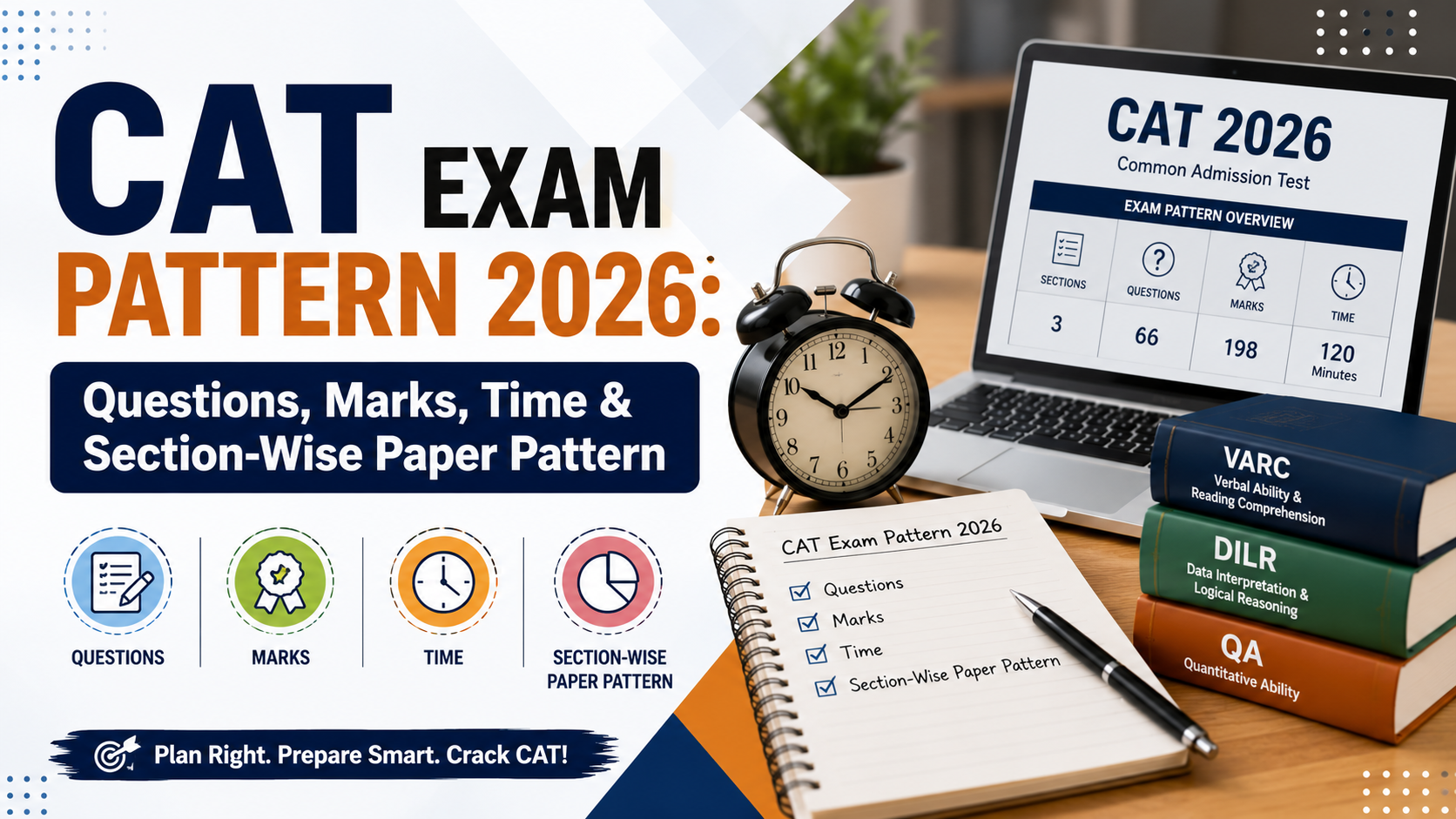
The CAT 2026 exam pattern is a computer-based test split into three fixed sections with a total duration of 120 minutes. You get exactly 40 minutes per section. And the paper contains a mixture of multiple-choice questions and direct text-entry questions.
Here is a quick overview of the paper structure:
|
Particular |
CAT 2026 Expected Pattern |
|
Exam Mode |
Computer-based test (CBT) |
|
Total Sections |
3 (VARC, DILR, QA) |
|
Total Questions |
68* |
|
Maximum Marks |
204* |
|
Total Duration |
120 minutes |
|
Sectional Time Limit |
40 minutes per section |
|
Question Formats |
MCQs and TITA (Non-MCQ) |
|
Marking for Correct Answer |
+3 marks |
|
Marking for Wrong MCQ |
-1 mark |
|
Marking for Wrong TITA |
No negative marking (0) |
Note: These figures are based on recent exam trends. Always consult the official CAT 2026 notification for final confirmed details.
How Many Questions Are There in CAT 2026?
The CAT 2026 exam is expected to have 68 questions in total. This overall count has remained consistent over recent test cycles, giving candidates a reliable baseline for their speed and accuracy targets.
CAT 2026 Section-Wise Question Distribution
|
Section |
Questions |
Maximum Marks |
Time Limit |
|
VARC |
24 |
72 |
40 minutes |
|
DILR |
22 |
66 |
40 minutes |
|
QA |
22 |
66 |
40 minutes |
|
Total |
68 |
204 |
120 minutes |
Knowing the exact number of questions per section helps you build a sensible pacing plan. Because each area has its own separate timer, you cannot collect time from an easier section to spend on a harder one later. You have to make every minute count within its own window.
What Are the Three Sections in CAT 2026?
The test evaluates your skills across three core areas: Verbal Ability and Reading Comprehension (VARC), Data Interpretation and Logical Reasoning (DILR) and Quantitative Aptitude (QA). Each section tests a completely different mental skill set under strict time constraints.
-
VARC — Verbal Ability and Reading Comprehension
VARC gives you 24 questions to solve in 40 minutes. Reading passages make up most of this section, usually covering 16 questions. The remaining 8 questions check your basic English skills through paragraph summaries, jumbled sentences and finding odd sentences out.
-
DILR — Data Interpretation and Logical Reasoning
DILR features 22 questions split into small set puzzles. Instead of single questions, you get charts, tables or seating puzzles with 4 or 5 questions attached to each set. Choosing an easy set first helps you secure quick marks without wasting time. If set selection feels confusing, taking one on one classescan help you spot easy puzzle patterns much faster.
-
QA — Quantitative Aptitude
QA includes 22 math questions that test your speed and basic calculation skills. Most questions come from Arithmetic and Algebra, with a few from Geometry, Modern Math and Number Systems. You will see both multiple-choice questions and direct-entry questions here.
How Does the CAT 2026 Time Limit Work?
The CAT exam features a total time limit of 120 minutes. It is divided into strict 40-minute windows for each of the three sections. The sectional timer starts automatically when a new section opens and runs down without pausing.
|
Section |
Time Window |
Approx. Question Count |
|
VARC |
40 minutes |
24 questions |
|
DILR |
40 minutes |
22 questions |
|
QA |
40 minutes |
22 questions |
This strict boundary means your time management must be section-specific. If you finish your VARC questions early, those leftover minutes will simply disappear. You cannot carry extra time into DILR or QA. Once your 40 minutes expire, the screen locks and automatically moves you to the next section.
What Is the CAT 2026 Marking Scheme?
The CAT 2026 marking scheme awards +3 marks for every correct response and deducts 1 mark for every incorrect MCQ attempt. Unattempted questions do not gain or lose any points.
-
How Many Marks Are Awarded for a Correct Answer?
Every correct answer adds +3 marks to your raw score, regardless of which section or question format you are solving. With 68 questions on the paper, the maximum possible raw score stands at 204 marks.
-
Is There Negative Marking in CAT?
Yes, negative marking applies to standard multiple-choice questions. A wrong pick on an MCQ costs you -1 mark, which can quickly drain your total score if you guess blindly. However, non-MCQ questions carry zero penalty for wrong answers.
-
How Does TITA Marking Differ From MCQ Marking?
Type In The Answer (TITA) questions carry no negative marking penalty. This structural difference makes TITA questions risk-free to attempt, even if you are not entirely sure of your final calculation.
|
Response Type |
Correct Answer |
Incorrect Answer |
Unattempted |
|
MCQ |
+3 |
-1 |
0 |
|
TITA (Non-MCQ) |
+3 |
0 |
0 |
What Types of Questions Are Asked in CAT 2026?
CAT exam papers use two distinct question formats: Multiple-Choice Questions (MCQs) and Type In The Answer (TITA) questions. Each format requires a slightly different approach during the test.
-
MCQs (Multiple-Choice Questions)
MCQs offer four option choices on the screen. You simply click the radio button next to your chosen response. Since a wrong attempt costs you -1 mark, avoid wild guessing unless you can safely cross out two incorrect options.
-
TITA Questions (Type In The Answer)
TITA questions do not give you any options. Instead, you type your answer directly into the text box using the on-screen keyboard or mouse. Because there is no negative marking for TITA items, try to answer every single one before your timer runs out.
Can You Switch Between CAT Sections?
No, you cannot move between sections while taking the CAT exam. The test follows a strict order that every candidate must follow: VARC first, DILR second and QA last.
The computer locks your screen to one section for its entire 40-minute duration. You cannot jump ahead to Quantitative Aptitude while working on Verbal Ability, nor can you go back to check a DILR set after its time runs out. Because of this lock, you need a separate 40-minute plan for each section instead of one single strategy for the whole test.
Is a Calculator Allowed in CAT 2026?
Yes, you get a basic on-screen calculator inside the test system. Physical calculators, smartwatches, and external paper gadgets are strictly banned in the exam hall.
The digital calculator lets you add, subtract, multiply, and divide. However, clicking buttons with a computer mouse takes extra time. Students who practise with learning platforms like SSSi often learn mental math tricks early so they only use the screen calculator for long, heavy calculations.
How Has the CAT Exam Pattern Changed in Recent Years?
The broad structure of three sections and a 120-minute duration has remained steady, but the overall question count was reduced in recent years to ease candidate stress.
|
Exam Year |
Total Questions |
Total Duration |
Pattern Overview |
|
CAT 2021 |
66 |
120 minutes |
3 sections (24 VARC, 20 DILR, 22 QA) |
|
CAT 2022 |
66 |
120 minutes |
3 sections (24 VARC, 20 DILR, 22 QA) |
|
CAT 2023 |
66 |
120 minutes |
3 sections (24 VARC, 20 DILR, 22 QA) |
|
CAT 2024 |
68 |
120 minutes |
Slight increase in total questions |
|
CAT 2025 |
68 |
120 minutes |
68-question structure retained |
|
CAT 2026 |
68* |
120 minutes* |
Expected pattern based on recent trends |
The 3 section, 120-minute structure has stayed stable in recent years, though the exact distribution of questions can shift slightly from year to year.
What Does the CAT 2026 Pattern Mean for Your Preparation?
Understanding the paper layout helps you train smarter. Here are four simple ways to adapt your study routine:
- Train with strict sectional timers
Practise solving problem sets in 40-minute blocks to build a natural sense of time for each section.
- Prioritise accuracy over wild attempts
The -1 penalty on MCQs can quickly ruin a good score. Know when it is best to skip a tricky question.
- Never leave a TITA question blank
Non-MCQ items carry zero penalty for wrong answers, so always type in your best guess before time runs out.
- Take full-length mock tests regularly
Practise timed mocks on a desktop screen so the fixed section sequence and digital calculator feel natural on test day. Many aspirants combine self-study with structured online tuition classesto get regular feedback on where they lose precious minutes during timed runs.
CAT Exam Pattern 2026 vs CAT Syllabus 2026 — What's the Difference?
Many candidates confuse the exam pattern with the CAT exam syllabus. But they cover two completely different aspects of your preparation.
The CAT Exam Pattern defines how the test is structured. It covers the number of questions, total marks, time limits, marking rules and section order.
The CAT Syllabus defines what academic content is tested. It lists specific subject topics such as Arithmetic, Algebra, Geometry, Reading Comprehension, and Data Sets. Think of the pattern as the rules of the game, while the syllabus is the material you study to play it well.
Frequently Asked Questions
-
Is CAT 2026 conducted online or offline?
CAT is a computer-based test conducted at designated official exam centres across India. Candidates read questions on a computer screen and submit their answers using a digital interface, though rough paper sheets are provided for manual calculations.
-
Can I choose which CAT section to attempt first?
No, candidates cannot change the order of sections. The exam follows a mandatory fixed sequence starting with Verbal Ability and Reading Comprehension, moving to Data Interpretation and Logical Reasoning and finishing with Quantitative Aptitude.
-
Can I leave questions unanswered in CAT?
Yes, you can leave any question unanswered without incurring a penalty. Unattempted questions carry zero marks and do not affect your overall accuracy record.
-
Does CAT have descriptive essay questions?
No, CAT consists entirely of objective-style questions. The paper features standard multiple-choice questions (MCQs) alongside non-MCQ (TITA) questions where you type numbers into an answer box.
-
Are all CAT sections equally timed?
Yes, every section receives an identical 40-minute window. You cannot adjust these sectional timers or transfer unused minutes from one section to another.
-
Can the CAT exam pattern change from the expected pattern?
Yes, the conducting IIM holds full authority to adjust question counts or timing rules. You should always treat the official CAT 2026 notification as the ultimate source for confirmed details.