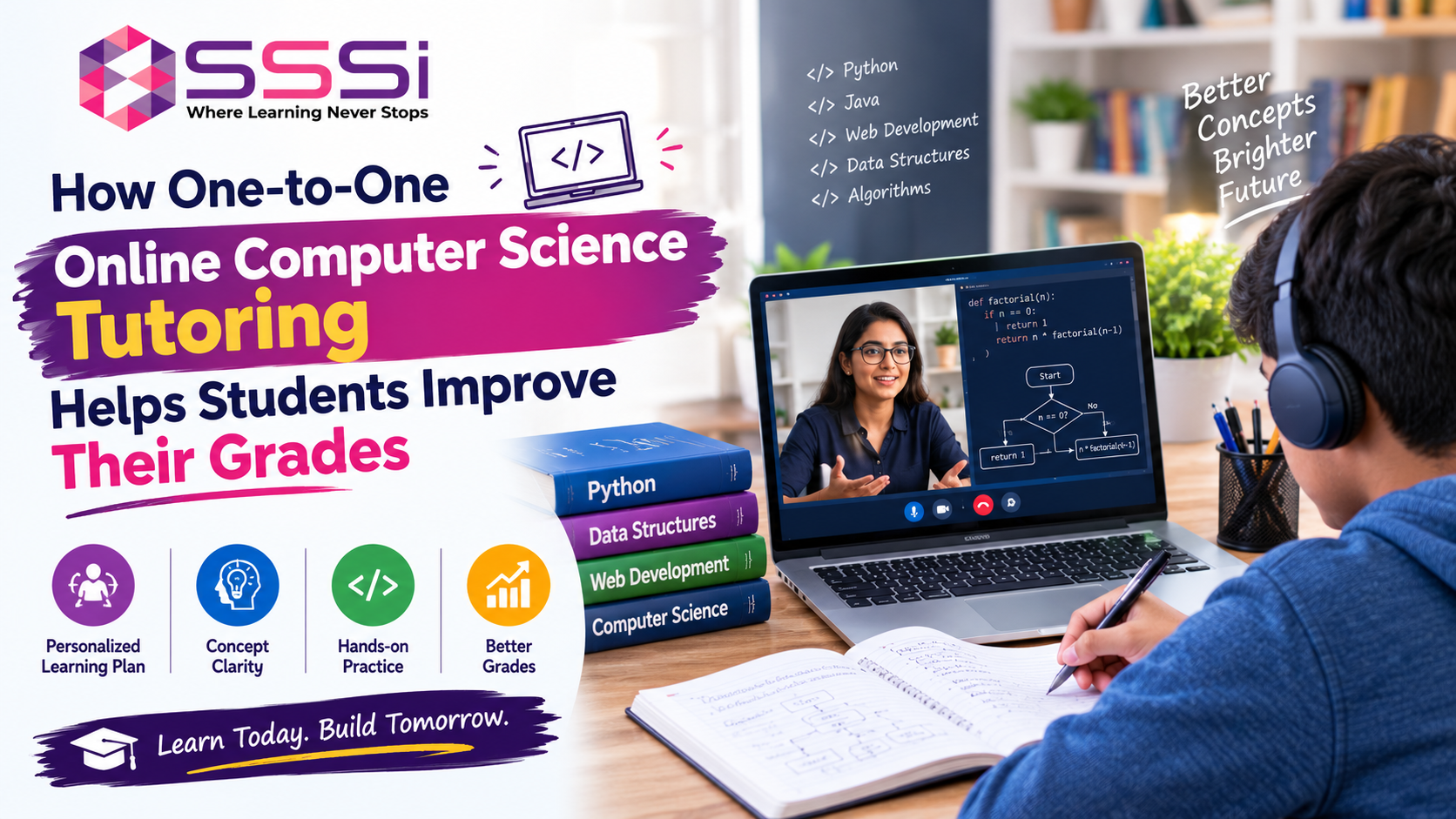
One-to-one online computer science tutoring helps students improve their grades by pairing them with an expert who explains programming concepts at their pace, debugs their code with them in real time, and prepares them for exams. For a subject where one missed concept can block everything that follows, personal guidance makes a big difference.
Computer science is unlike most school subjects. It demands logical thinking, precise syntax, and hands-on practice, and many students feel lost when a class moves too fast. This guide explains why personalised tutoring works so well for CS and how it leads to better marks.
Why Do Students Struggle in Computer Science?
Common reasons include:
- Cumulative concepts: Variables, loops, functions, and data structures build on each other. Miss one and the next topic feels impossible.
- Large class sizes: Teachers can rarely help each student debug individually.
- Fear of errors: Red error messages discourage beginners, who often stop asking for help.
- Memorising instead of understanding: Copying code without knowing why it works leads to failure in exams.
- Limited practice: Coding is a skill, and it needs regular guided practice.
What Is One-to-One Online Computer Science Tutoring?
It is a private live session between one student and one qualified computer science tutor, held over video call with screen sharing, a digital whiteboard, and a shared code editor. The tutor watches the student write code, spots mistakes instantly, and explains concepts step by step. Sessions can cover school curricula (CBSE, ICSE, IGCSE, IB, A-Levels, AP Computer Science) and languages such as Python, Java, C++, and JavaScript.
8 Ways One-to-One Online Computer Science Tutoring Improves Grades
1. Personalised Learning Plans
A tutor begins by assessing the student’s current level, then builds a plan around weak areas such as loops, recursion, or object-oriented programming. Nothing is rushed, and nothing already mastered is repeated.
2. Real-Time Debugging and Code Review
This is the biggest advantage. With screen sharing, the tutor sees exactly where the code breaks and teaches the student how to read error messages and fix bugs independently. Programming help in the moment turns frustration into understanding.
3. Stronger Logical and Problem-Solving Skills
Good tutors teach students to break a problem into steps, write pseudocode, and test their solutions. These skills improve performance in both practical and written exams, and help in maths and science too.
4. Foundational Gaps Get Fixed
If a student never understood how variables or conditionals work, later topics like arrays and algorithms will feel confusing. A tutor traces the problem back to its root and rebuilds the basics.
5. A Safe Space to Ask “Basic” Questions
Many students avoid asking questions in class for fear of looking slow. In a private session, they can ask freely, make mistakes openly, and learn from them.
6. Focused Exam Preparation
Tutors teach exam-specific skills: tracing code by hand, writing algorithms, answering theory questions on networks, databases, and Boolean logic, and managing time. Computer Science exam preparation with past papers and mock tests builds confidence before the real thing.
7. Project and Coursework Support
Many boards include practical work, coding projects, or a non-exam assessment. A tutor guides planning, structure, testing, and documentation, while making sure the student does the work and truly understands it.
8. Flexible, Convenient Scheduling
Online sessions remove travel time and fit around school and activities. Recorded sessions let students revisit explanations before tests, and consistent weekly practice leads to steady improvement.
What Does the Research Say?
Educational psychologist Benjamin Bloom’s 1984 research found that students taught one-to-one with mastery-based methods performed far better than those in conventional classrooms, a result known as the “2 Sigma Problem”. Results vary by student and tutor, but the principle applies strongly to coding: immediate feedback and guided practice speed up learning.
How to Choose the Right Computer Science Tutor
- Subject expertise in your child’s curriculum and programming language
- Real coding or industry experience, plus teaching experience with the student’s age group
- A free demo class to check teaching style and rapport
- A structured syllabus with clear goals, assignments, and regular assessments
- Good tools: screen sharing, a shared code editor, and a digital whiteboard
- Regular parent updates on progress and areas to improve
6 Tips to Get the Best Results
- Set specific goals, such as “move from a C to a B in CS this term.”
- Install the required software (Python, IDE) before the first session.
- Write code, don’t just watch. Active practice matters most.
- Bring errors and questions to every session.
- Practise between sessions with small daily exercises.
- Be consistent. Two sessions a week usually beat irregular ones.
Frequently Asked Questions
Is one-to-one online computer science tutoring effective?
Yes. Screen sharing and live code editors let a tutor guide a student as closely as in person, often with added convenience and recorded lessons.
Can a beginner with no coding experience start?
Yes. A good tutor starts from the basics and builds up step by step.
Which programming language should my child learn first?
Python is a popular first choice for its simple syntax. The right choice also depends on the school curriculum, such as Java for AP Computer Science A.
How soon will grades improve?
Many students feel more confident within a few weeks. Measurable grade improvement usually appears within one to three months, depending on consistency and starting level.
Will tutoring help with exam preparation as well as coding?
Yes. Tutors cover both practical coding and theory topics, along with past-paper practice and exam technique.
Is it suitable for school-age children?
Yes. Younger students can start with visual tools like Scratch before moving to text-based languages.
Conclusion
One-to-one online computer science tutoring gives students undivided attention, instant feedback on their code, and a clear path through difficult topics. By fixing foundations, building problem-solving skills, and preparing smartly for exams, it helps students move from confusion to confidence and from average grades to excellent ones.